 @natematias
 @natematias
Strange Stability: Learning from Scientific Myths of the Nuclear Age
Published:
This summer, when I read yet more statements from scientists warning of catastrophes from future technology, I felt enlightened for the very first time. The statements were not from 2026, and the technology was not AI. Instead the year was 1968 and the issue was existential risk from weapons that could destroy or protect whole cities in a nuclear war.
In the new book Strange Stability, Harvard historian of science Benjamin Wilson shares the receipts (literally) on what he calls the “doctrine of development without deployment” that funded the endless frontier of cold war science. In this telling, experts at universities and think tanks gained power and money by advising the government, performing arms control advocacy in public, and working for weapons-makers in private.
While reading Wilson’s book, I made a bingo card of topics that could easily apply to debates about AI and tech policy in 2026. Here’s a short list:
- Technologists who argue that more research and development of dangerous systems is the only way to protect society
- Scientists who keep secret their investments and consulting for the tech industry while working backstage with industry to gain influential roles in government and universities
- Definitions of good science that are designed to support the politics of profit and war, and to filter out truly independent voices
- Debates about basic research, and whether independent scientists can ever discover fundamental principles that offer anything useful to policymakers
- A broad public movement against technology deployment driven by concerns about dangerous, polluting facilities in people’s back yards
- The idea of the whistleblower, a category of hero created by the media that sometimes permits insiders to keep profiting from industries that they mildly critique in public
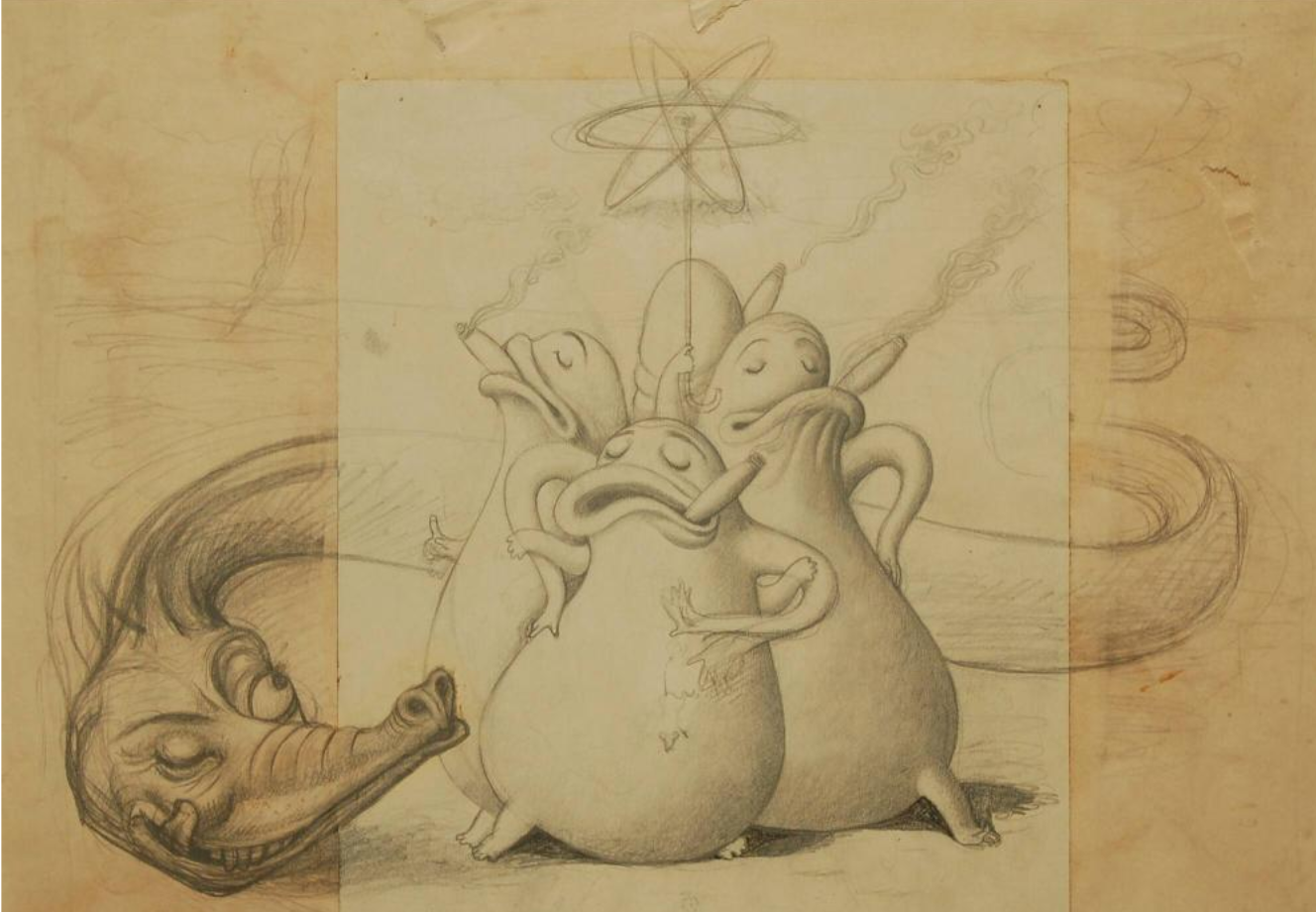 In this 1946 sketch by TIME magazine cover artist Boris Artzybasheff, US leaders protect themselves with a nuclear umbrella from a circling snake. Source: Syracuse University archives.
I am not a historian of science nor a nuclear expert, and it took work to follow Wilson’s descriptions of rocket physics and mid-century systems thinking. Yet these details support an argument about some of the biggest questions in science and democracy—interspersed with juicy revelations and backroom drama in the private letters, unclassified records, and receipts of famous scientists.
In one astonishing tale, Wilson shows how the physicists Hans Bethe and Richard Garwin were re-cast through “assertive hand-holding” by Scientific American into becoming accidental nuclear whistleblowers—after submitting a draft to support the weapon their article eventually opposed. As Wilson tells it, their example became an influential template for a later generation who formalized the idea of the public-interest independent nuclear scientist. Those later scientist-activists didn’t realize that Bethe and Garwin were simultaneously cashing in on contracts with weapons makers.
Whoever has taken up the mantle of history of science farce from Tom Stoppard and Michael Frayn needs to make Wilson’s book into a play or TV drama.
 On a bicycle ride through Los Alamos this summer, I saw a record of the last Pope’s statement on a consequential technology
Lessons for Tech Policy from Strange Stability
What have I learned from Strange Stability for my own tech policy work? I’m not an expert on the history of science, but here are some of the lessons I’m pondering after reading Wilson’s book.
First, look for fights over concepts that conceal more than they clarify. In the nuclear era, one such term was “stability.” In AI debates, the words might be “safety” or “alignment.” Industry insiders know that if they can define the meaning of those words, they can steer public debate and government policy to their advantage. And as Wilson shows in the lives of famous scientists, big concepts like safety and stability can be made to mean whatever you need them to mean at the moment.
Second, when we’re told to trust truth-tellers with insider knowledge, we need to ask how they got there and who benefits from their claims. When President Eisenhower warned Americans about the military industrial complex in 1961, he was describing a tightly-embedded network of people with a record of public service. Their work led to financial interests that were symbiotic with American military spending but hidden from voters. In Wilson’s telling, this network was so effective that even reforms like conflict of interest policies were redirected into protecting them from accountability.
This performance works best when experts can convince you to focus on speculative harms rather than what you can see with your own eyes. In a review of Wilson’s book for the U.S. Naval Institute, Commander Michael Axel argues that nuclear weapons have a unique characteristic that made physicists and other scientists especially influential: when weapons are rarely used, policymakers feel pressured to rely on speculative forecasting from experts. I expect David Karpf’s upcoming book Vaporware Inc. will explain how digital technologists make exactly the same speculative move.
Any argument between experts over the science of AI is also a fight over who will get money and influence. When well-funded luminaries try to scare us with apocalyptic tales of future AI, I wonder if they are trying to re-create something like the military industrial complex and the job security that comes with it. When civic leaders are given the chance to sign onto their statements, it offers the chance of combining a moral voice with proximity to power and money.
When I and other industry-independent scientists argue that AI is already widely-deployed and that we need independent evaluation, we are also making a financial argument grounded in the economics of research integrity. That’s one reason I contributed to the book Auditing AI and my article on tech safety with Amy Orben in Science. In my view, people in government, nonprofits, universities, and auditing firms should have stable middle-class jobs to provide independent evidence on the safety and reliability of AI—just like we have with medicine, cars, food, chemistry, and the environment.
 Rainclouds swept through the Jemez Mountains as I started my ascent.
The Human Consequences of Strange Stability
I started listening to Wilson’s book on a trip I took in June to Santa Fe and the Jemez Mountains that surround Los Alamos. I traveled to speak about independent research at an AI workshop at the Santa Fe Institute, one of the institutions later shaped by the forces Wilson describes.
On a multi-day bicycle ride through small towns, tribal nations, and places of deep history and ceremony, I gained a new appreciation for the complex politics of dangerous technologies. On one hand, the nuclear and defense industries, drawn by uranium deposits and open areas for weapons testing, have helped the state navigate 20th century challenges of industrial decline. On the other hand, radiation from nuclear mining and tests has caused irreversible multi-generational health costs, and the state is now struggling with growth that overstretches their water supply (see John Fleck’s new book Ribbons of Green).
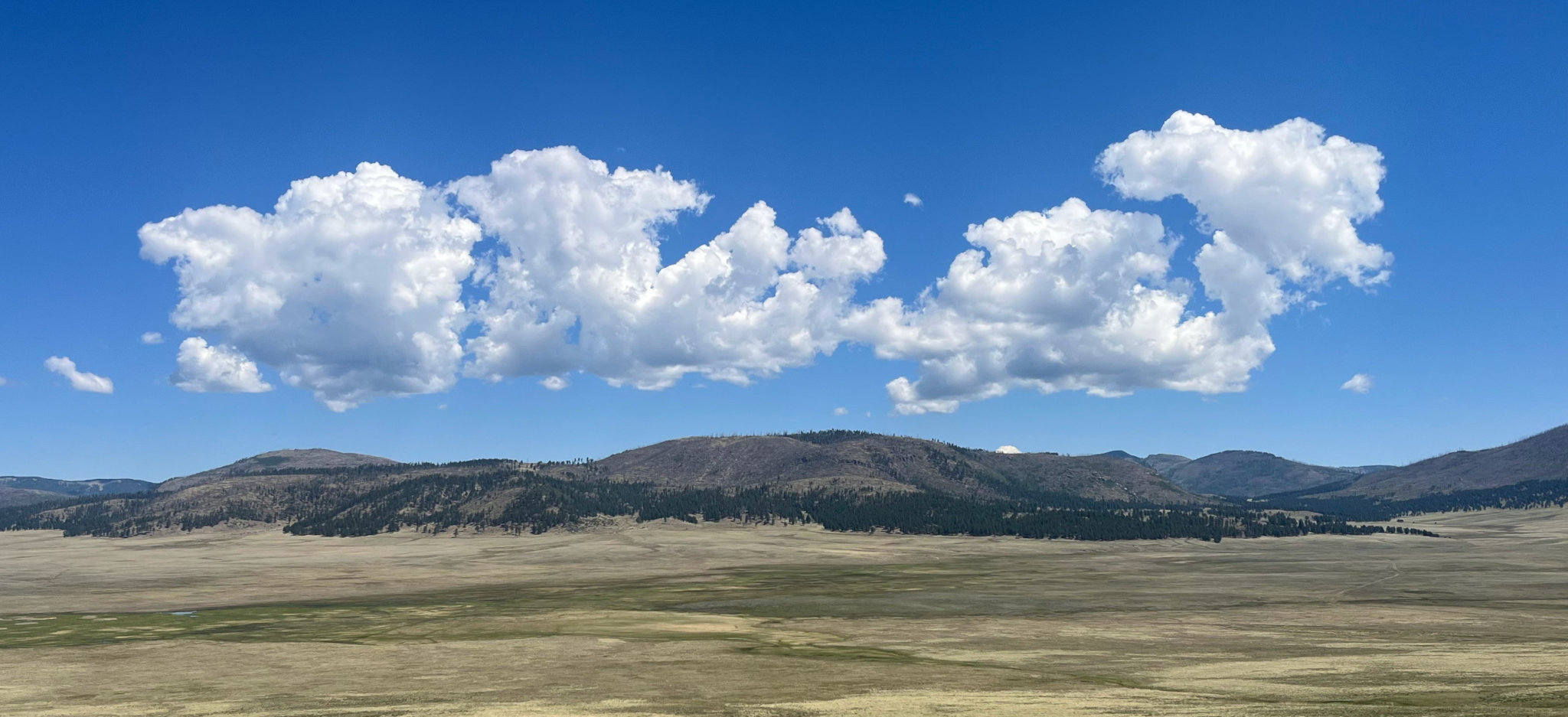
At a country store outside the stunning Valles Caldera (the photo on top), I sat for an hour with an elderly man who camps in his pickup under the stars as much as he can. He had stopped for water before heading to the mountains in-between medical visits now that his wife has passed away. They originally moved to New Mexico in the summer of love and never left. The desert and the mountains kept them looking up, finding meaning on roads sustained across centuries of conflicts over colonization, resource extraction, and the military industrial complex.
When our conversation turned to AI, water, politics, and war, he suddenly interrupted and asked me to look at his phone. Showing me the photo of a young bird that hopped into his hand that morning, he said “that’s what life is really about.” On the other side of the mountain from the miracles of science at Los Alamos, he found wonder and pride in holding and caring for new life in a beautiful universe.
I’m grateful to Benjamin Wilson for a tour of the dizzying world of experts who secretly profit from the things they critique. I came away from the book with a clearer sense of how messy it is to advocate for independent research in democracy. But as someone who works alongside affected communities, I’m also grateful for all the moments of grace and human connection that keep me grounded along the way.

Resting at a country store west of the Valles Caldera for conversation and hydration on a hot summer day
Other Updates in the Extended Universe
- Last week, I published an article with the Union of Concerned Scientists that shares news of legal victories and support from leading scholarly societies, with tips for Protecting Science from Government Intimidation.
-
I’m now settled in the Boston area for my fellowship at the Radcliffe Institute and am looking forward to research, organizing, and creative community.
- CAT Lab’s former Deputy Director Elizabeth Eagen has taken on a new role as the Executive Director of the Calyx Institute, which defends privacy and works to keep people securely connected.
- Dr. Sarah Gilbert, together with Nathália Santos, have been debriefing communities on the relationship between levels of perceived AI use and community belonging in large-scale online cooperation. More details will be out soon!
- Dr. Bastian Greshake Tsovoras and I have had a wonderful summer supporting Computational Social Science Summer Schools in Kenya, Nigeria, and Burkina Faso to have deep conversations with Wikimedia movement leaders and develop collaboration ideas. More news on that soon! In the meantime, Bastian has written an excellent post about the idea of ‘scaling up’ and finding the right size for projects.
- Dr. Lucas Wright, who defended his PhD at Cornell this May, is spending the year at Yale, where he is a Resident Fellow of the Information Society Project before taking up a position as an assistant professor at Northeastern University.
- PhD student, Alexandra Gonzalez, spent the summer as a fellow at the Aspen Institute working on child safety and is currently in Germany at SOUPS co-leading a workshop on Community Building for Researchers on Generative AI-Facilitated Image-Based Abuse.
- Writing in Southern Cultures, our collaborator Shannon Dosemagen reflects on why people hold ground: climate change, system collapse, and home in New Orleans.
- Shannon also co-authored an important article on Constructing a New Knowledge Infrastructure, on ways that community science can link up to have more impact and staying power.
- CAT Lab data science consultant Dr. Ed Platt has started a blog series on what the history of perpetual motion machines can teach us about AI.
- CAT Lab community member Dr. Beatrys Rodrigues defended her PhD and was celebrated by Cornell’s Bouchet Honor Society for outstanding achievement in scholarship and service.
- This summer, UCR professor and former CAT Lab postdoc Dr. Avriel Epps launched IWNDR, a video series that is inspiring people to ask important questions about tech and take action. Avriel has said, “I am committing myself to going harder on systems, on institutions, on outdated norms, and being as soft as possible with the individual humans I interact with and speak about.”